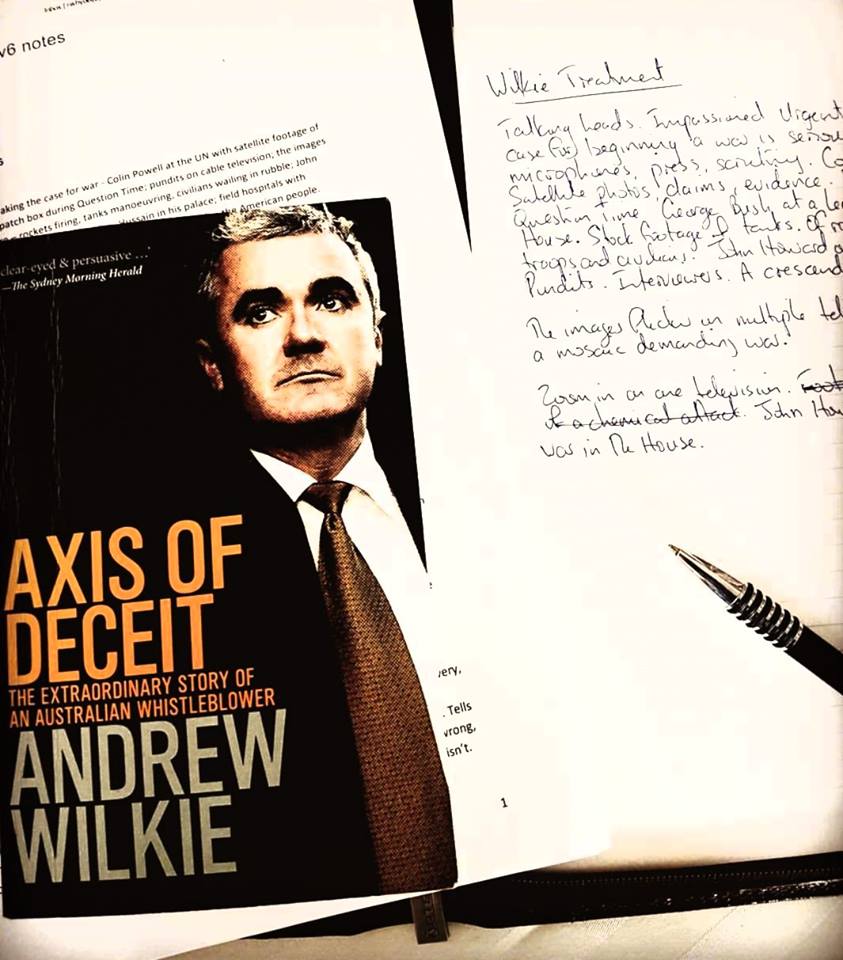
My head is spinning. It's like I've served a twenty year apprenticeship and now the universe has decided I actually know what I'm doing as a writer. This year has been nothing short of sensational so far. Not one but two feature screenplays in play with another feature project waiting in the wings. Not one but two proof of concept shorts with one already shot and close to being finished with the other being shot in less than a month.
I've been writing well for a sustained period. My key collaborators, Tim and Jaimee, have been spectacular. People are reaching out in amazing ways - new faces, old contacts, exciting opportunities.
I'm humbled and heartened by the response to my scripts from other writers, actors, crew, experienced practitioners whose opinion I value enormously, and the market. Tim, Jaimee, and I have been taking very positive meetings on Doomscroller while the Truth To Power feature is in for West Coast Visions, accompanied with a short I'm incredibly proud of.
More than that though, I've been able to assist people with their own projects; brokering introductions, providing feedback, and being an encouraging voice. My mantra is pretty simple - ‘when you get the chance, you do good things for good people’ so it's been a delight to help out where I can. It's also a joy to be surrounded by such positive creative talent.
Then there's the possibility of entering into a writing partnership that could be a dream scenario. Head. Spinning. Linda Blair style. Without the projectile vomit!
Yes, I know I'm an optimist and that a million things have to go right to get a film up but damn if we ain't poised nicely to, as my producer said on a film shoot recently, “turn this dream into a reality.”
And that's pretty damn exciting!
Showing posts with label screenwriting. Show all posts
Friday, March 28, 2025
Tuesday, December 4, 2018
Construction of a Screenplay, Part 7 - Patience
An underrated aspect of screenwriting is patience. Patience not to rush the development of a good idea. Patience waiting for feedback and notes. Patience in trusting your collaborators. Patience in the next steps that will hopefully turn words on a page into moving images on a screen.
Patience has never been one of my strengths. I used to get angsty waiting - on reader notes, the results of funding submissions and the like. But I'm learning and getting better.
The Truth to Power screenplay has been receiving really good feedback. It's out there being read and all I can do is wait. Positive things are happening behind the scenes and I am immensely buoyed by the number of people who ask me how it's going.
I can't give definitive answers yet other than I'm excited about the possibilities being presented.
And I am calm and happy to wait. Largely because I believe the script is good, it will find a home, and it will get made.
Once a producer (or producers) has been locked in then my waiting will be over.
I've had time away from those words on a page so when the notes come for rewrites I'll be able to attack them with fresh eyes. Plus any other material to assist getting the project up whether that be funding submissions or crowd funding campaigns. Decisions to discuss when a producer joins Tim and I to shepherd this project to the next phase.
I have a feeling 2019 is going to be a big year. It will be challenging, no doubt, but I'm excited about where this will lead us...
#TruthtoPower #screenwriting
Patience has never been one of my strengths. I used to get angsty waiting - on reader notes, the results of funding submissions and the like. But I'm learning and getting better.
The Truth to Power screenplay has been receiving really good feedback. It's out there being read and all I can do is wait. Positive things are happening behind the scenes and I am immensely buoyed by the number of people who ask me how it's going.
I can't give definitive answers yet other than I'm excited about the possibilities being presented.
And I am calm and happy to wait. Largely because I believe the script is good, it will find a home, and it will get made.
Once a producer (or producers) has been locked in then my waiting will be over.
I've had time away from those words on a page so when the notes come for rewrites I'll be able to attack them with fresh eyes. Plus any other material to assist getting the project up whether that be funding submissions or crowd funding campaigns. Decisions to discuss when a producer joins Tim and I to shepherd this project to the next phase.
I have a feeling 2019 is going to be a big year. It will be challenging, no doubt, but I'm excited about where this will lead us...
#TruthtoPower #screenwriting
Tuesday, September 18, 2018
Construction of a Screenplay, Part 6 - The Pitch Document
“I think it’s very good and happy for you to continue to develop it.”
After 15 months and ten drafts, with that response from Andrew Wilkie, we were ready to begin the search for a producer. There were several variables at play here. The director Tim Dean had been through a bad experience on a film project and was understandably leery about a repeat. The script had been written with a micro-budget in mind, possibly to be raised through crowdfunding. That would influence the profile of the producers we would initially approach. The tale was a political one therefore not only did we want a person (or persons) we could work with, critically they should also be as passionate about the topic as Tim and I were.
The option of producing it ourselves was never seriously considered. Especially after watching a two part documentary about an Australian filmmaker who made a horror film in, let’s just say, less than ideal circumstances. That thing scared the hell out of me and we wanted no part of that stress.
Tim and I talked it over and the agreed first step was to write a pitch document we could send out to gauge interest. Now, I may be a little cynical but the Australian funding model with its director statements and writer’s notes (don’t get me started) amongst other requirements wasn’t conducive to what I had in mind. Yes, we used a logline, and a short synopsis but I wanted to clearly state why we wanted to make the film and how that fit into a tradition of great movies about people speaking truth to power whether in a political context (All The President’s Men) or corporate malfeasance (The Insider). This was also a uniquely Australian story with an international angle. Our trump card, of course, was that the subject of the film, Andrew Wilkie, was in our corner.
I sat down to write the first draft of the pitch document and it all came tumbling out. How Wilkie was an unlikely whistle-blower given his background; how the act of whistle-blowing has become increasingly high profile as governments seek to control information with greater rigour; how the West always does this – try and impose its will and values on other countries – and keeps making the same mistake; how democracy can only survive when courageous people speak out against the abuse of power and unregulated secrecy. Above all, what fascinates me is how a small number of citizens summon that courage to defy their government – the Wilkies, the Snowdens, the Mannings, and the Ellsbergs of the world.
As is our usual working process, Tim gave feedback and we kicked it around, trimming some elements but it essentially remained the same as that stream of consciousness draft. Tim had mocked up a cover page that I very much liked – the redacted look of the title with a picture of Wilkie at the top.
All that was left to do was to send it out to a select number of producers on the eastern seaboard that Tim knew or had been recommended and wait…
Always with the waiting!
After 15 months and ten drafts, with that response from Andrew Wilkie, we were ready to begin the search for a producer. There were several variables at play here. The director Tim Dean had been through a bad experience on a film project and was understandably leery about a repeat. The script had been written with a micro-budget in mind, possibly to be raised through crowdfunding. That would influence the profile of the producers we would initially approach. The tale was a political one therefore not only did we want a person (or persons) we could work with, critically they should also be as passionate about the topic as Tim and I were.
The option of producing it ourselves was never seriously considered. Especially after watching a two part documentary about an Australian filmmaker who made a horror film in, let’s just say, less than ideal circumstances. That thing scared the hell out of me and we wanted no part of that stress.
Tim and I talked it over and the agreed first step was to write a pitch document we could send out to gauge interest. Now, I may be a little cynical but the Australian funding model with its director statements and writer’s notes (don’t get me started) amongst other requirements wasn’t conducive to what I had in mind. Yes, we used a logline, and a short synopsis but I wanted to clearly state why we wanted to make the film and how that fit into a tradition of great movies about people speaking truth to power whether in a political context (All The President’s Men) or corporate malfeasance (The Insider). This was also a uniquely Australian story with an international angle. Our trump card, of course, was that the subject of the film, Andrew Wilkie, was in our corner.
I sat down to write the first draft of the pitch document and it all came tumbling out. How Wilkie was an unlikely whistle-blower given his background; how the act of whistle-blowing has become increasingly high profile as governments seek to control information with greater rigour; how the West always does this – try and impose its will and values on other countries – and keeps making the same mistake; how democracy can only survive when courageous people speak out against the abuse of power and unregulated secrecy. Above all, what fascinates me is how a small number of citizens summon that courage to defy their government – the Wilkies, the Snowdens, the Mannings, and the Ellsbergs of the world.
As is our usual working process, Tim gave feedback and we kicked it around, trimming some elements but it essentially remained the same as that stream of consciousness draft. Tim had mocked up a cover page that I very much liked – the redacted look of the title with a picture of Wilkie at the top.
All that was left to do was to send it out to a select number of producers on the eastern seaboard that Tim knew or had been recommended and wait…
Always with the waiting!
Wednesday, August 29, 2018
Construction of a Screenplay, Part 5 - Script Development, Phase Two
After almost a year of developing the screenplay for Truth to Power we finally had a draft that Tim Dean (director) and I were happy to send to Andrew Wilkie. This was a major moment in the life of the project.
A quick refresher. Famously, Wilkie was the only western intelligence officer who resigned in protest before the 2003 Iraq War as he believed the governments of Australia, the US, and Britain were prosecuting the war on a lie. That lie being that Iraq possessed weapons of mass destruction and had ties to Al Qaeda. Subsequent events and several inquiries were to prove Wilkie correct.
He paid a steep price for this as most whistle-blowers do when they speak truth to power. Remarkably, however, he is now an independent member of the Australian Federal Parliament. The Truth to Power screenplay is an adaptation of his book Axis of Deceit.
What the book couldn’t tell me, nor the subsequent research, is what the then intelligence analyst’s emotional journey was during this time. All direct communication with Wilkie was conducted through Tim which commenced several years before my involvement. It was an arrangement I was happy to continue though there was talk of trying to organise either a visit to Canberra or a videoconference. Alas, Wilkie’s parliamentary duties made that highly unlikely. I filled in the gaps as best I could and trusted that we weren’t too far off base. There were elements in the script, however, that I wasn’t sure how he would react to. Overall though, I was happy with where we were at.
It was a 7th draft that was dispatched towards the end of October 2017. We wouldn’t get a response until early January 2018. Usually I am not a patient person when it comes to waiting for feedback but I largely put it out of my mind. Tim and I continued to work on the screenplay until Wilkie came back to us.
The results, communicated via Tim, were positive. Wilkie liked the script and the approach we had taken. But there were two areas he disagreed with. One was totally expected – I had used a claim made against Wilkie from his cadet days as the basis of a three beat arc that culminated in a moment of self-reflection during the climax of the script. Wilkie did not recall the alleged incident and therefore it had to go. He understood what we were trying to do by incorporating it though. And that was important to me.
The other issue was far more problematic. While he apparently did not object to the portrayal of the relationship with his then wife Simone, he was adamant he was not in contact with her during the timeframe of the script. Therefore, it too had to go. The emotional spine of that draft! This caused much consternation with Tim mulling the chances of getting Wilkie to change his mind. I suspect that was never a realistic proposition so we set about rewrites and the daunting prospect of reinventing the emotional through line of the screenplay.
My first stab at this was a serviceable scene set well before the events of the story proper… but it didn’t really fit the structure or tone of the screenplay. It was backstory for the purposes of trying to retain a character. It was never going to work. But it was necessary to get that out of our system and discover another way.
Wilkie had given Tim the clue – his concern about what the impact would be on his father if he chose to make a stand. Interestingly, the father had been in the treatment and early drafts. He dropped out as a character as we focussed on Simone. He was about to make a major comeback as these things go in the development of a script.
After three drafts of rewrites that took a couple of months from Wilkie’s initial feedback we sent him the tenth draft on 12 March 2018. His response exactly one month later – “I think it’s very good and happy for you to continue developing it.”
It was now time to start looking for a producer…
A quick refresher. Famously, Wilkie was the only western intelligence officer who resigned in protest before the 2003 Iraq War as he believed the governments of Australia, the US, and Britain were prosecuting the war on a lie. That lie being that Iraq possessed weapons of mass destruction and had ties to Al Qaeda. Subsequent events and several inquiries were to prove Wilkie correct.
He paid a steep price for this as most whistle-blowers do when they speak truth to power. Remarkably, however, he is now an independent member of the Australian Federal Parliament. The Truth to Power screenplay is an adaptation of his book Axis of Deceit.
What the book couldn’t tell me, nor the subsequent research, is what the then intelligence analyst’s emotional journey was during this time. All direct communication with Wilkie was conducted through Tim which commenced several years before my involvement. It was an arrangement I was happy to continue though there was talk of trying to organise either a visit to Canberra or a videoconference. Alas, Wilkie’s parliamentary duties made that highly unlikely. I filled in the gaps as best I could and trusted that we weren’t too far off base. There were elements in the script, however, that I wasn’t sure how he would react to. Overall though, I was happy with where we were at.
It was a 7th draft that was dispatched towards the end of October 2017. We wouldn’t get a response until early January 2018. Usually I am not a patient person when it comes to waiting for feedback but I largely put it out of my mind. Tim and I continued to work on the screenplay until Wilkie came back to us.
The results, communicated via Tim, were positive. Wilkie liked the script and the approach we had taken. But there were two areas he disagreed with. One was totally expected – I had used a claim made against Wilkie from his cadet days as the basis of a three beat arc that culminated in a moment of self-reflection during the climax of the script. Wilkie did not recall the alleged incident and therefore it had to go. He understood what we were trying to do by incorporating it though. And that was important to me.
The other issue was far more problematic. While he apparently did not object to the portrayal of the relationship with his then wife Simone, he was adamant he was not in contact with her during the timeframe of the script. Therefore, it too had to go. The emotional spine of that draft! This caused much consternation with Tim mulling the chances of getting Wilkie to change his mind. I suspect that was never a realistic proposition so we set about rewrites and the daunting prospect of reinventing the emotional through line of the screenplay.
My first stab at this was a serviceable scene set well before the events of the story proper… but it didn’t really fit the structure or tone of the screenplay. It was backstory for the purposes of trying to retain a character. It was never going to work. But it was necessary to get that out of our system and discover another way.
Wilkie had given Tim the clue – his concern about what the impact would be on his father if he chose to make a stand. Interestingly, the father had been in the treatment and early drafts. He dropped out as a character as we focussed on Simone. He was about to make a major comeback as these things go in the development of a script.
After three drafts of rewrites that took a couple of months from Wilkie’s initial feedback we sent him the tenth draft on 12 March 2018. His response exactly one month later – “I think it’s very good and happy for you to continue developing it.”
It was now time to start looking for a producer…
Sunday, July 15, 2018
Construction of a Screenplay, Part 4 - Script Development, Phase One
By the middle of January 2017 we had a first draft of the Truth to Power screenplay. A good beginning six months into the process. What happens now? The answer is the first phase of an intensive period of rewrites before what would be the seventh draft was sent to Andrew Wilkie at the end of October.
The director Tim Dean and I would bat notes back and forth and have regular video conferencing sessions to discuss the state of the script. Tim is very good at giving notes (apart from the occasional ‘can we just make this better?’ which is always a fun note to get!) and they would become more specific the deeper we went into rewrites. These covered the whole gamut of elements from character, tone, structure, transitions, theme, dissection of scenes, and, eventually, decisions to kill some of my ‘babies’. Those being scenes that I would hang onto from draft to draft but ultimately didn’t fit for whatever reason. Vale a couple of favourites.
As the structure had been developed over the previous six months it was fairly robust which allowed me to try new things without too much ensuing chaos. We focussed on character work, notably for Wilkie, his wife Simone, and his colleague Kate; as well as getting the main structural beats as strong as possible – inciting incident, first act turning point, midpoint, and the ‘death point’-helping hand-turning point at the end of the second act. The opening sequence and climax were already locked in though they were tweaked as well.
The most difficult elements were getting the character of Kate Burton to a place we thought was accurate and servicing the story; and the beats at the end of the second act. This is the sequence I have easily rewritten more times than any other section of the script.
As Tim and I were on other sides of the country we used Wire which is a fully encrypted video application. Indeed, all our communications were encrypted – Signal for messaging, Proton Mail for sending drafts and notes. There was some sensitivity around the project given the subject matter and a history of interference with the real-life subjects in the past. I am breaking cover with these blog posts! Gulp.
The other strategy we employed was kicking material out to readers for feedback. This started with the Treatment and continues to this very day with drafts. My preferred option in receiving feedback from readers is in a face-to-face meeting. I find the interaction stimulates a wide-ranging discussion that allows me to question the reader; them to do the same with me; and basically explore the state of the script in greater detail. To that end I would offer to shout for food & drinks at a meeting place of the reader’s choice. I’m sure I can claim this as expenses against our ultra-low budget production… can’t I Tim? Damn.
A big thank you, therefore, to the following people I met with to discuss the Treatment and/or a Draft:
Scott McArdle, Phil Jeng Kane, Levon Polinelli, Nick Maclaine, Anna Bennetts, and Tyler Jacob Jones. Plus the people Tim sent the script to on his side of the country.
But there was one reader above all that we were keen to get feedback from. So after seven drafts Tim and I finally felt ready to send Andrew Wilkie the script. This was around the end of October 2017.
Then we waited… and waited… and waited some more…
Next in Part 5 – Script Development, Phase Two
The director Tim Dean and I would bat notes back and forth and have regular video conferencing sessions to discuss the state of the script. Tim is very good at giving notes (apart from the occasional ‘can we just make this better?’ which is always a fun note to get!) and they would become more specific the deeper we went into rewrites. These covered the whole gamut of elements from character, tone, structure, transitions, theme, dissection of scenes, and, eventually, decisions to kill some of my ‘babies’. Those being scenes that I would hang onto from draft to draft but ultimately didn’t fit for whatever reason. Vale a couple of favourites.
As the structure had been developed over the previous six months it was fairly robust which allowed me to try new things without too much ensuing chaos. We focussed on character work, notably for Wilkie, his wife Simone, and his colleague Kate; as well as getting the main structural beats as strong as possible – inciting incident, first act turning point, midpoint, and the ‘death point’-helping hand-turning point at the end of the second act. The opening sequence and climax were already locked in though they were tweaked as well.
The most difficult elements were getting the character of Kate Burton to a place we thought was accurate and servicing the story; and the beats at the end of the second act. This is the sequence I have easily rewritten more times than any other section of the script.
As Tim and I were on other sides of the country we used Wire which is a fully encrypted video application. Indeed, all our communications were encrypted – Signal for messaging, Proton Mail for sending drafts and notes. There was some sensitivity around the project given the subject matter and a history of interference with the real-life subjects in the past. I am breaking cover with these blog posts! Gulp.
The other strategy we employed was kicking material out to readers for feedback. This started with the Treatment and continues to this very day with drafts. My preferred option in receiving feedback from readers is in a face-to-face meeting. I find the interaction stimulates a wide-ranging discussion that allows me to question the reader; them to do the same with me; and basically explore the state of the script in greater detail. To that end I would offer to shout for food & drinks at a meeting place of the reader’s choice. I’m sure I can claim this as expenses against our ultra-low budget production… can’t I Tim? Damn.
A big thank you, therefore, to the following people I met with to discuss the Treatment and/or a Draft:
Scott McArdle, Phil Jeng Kane, Levon Polinelli, Nick Maclaine, Anna Bennetts, and Tyler Jacob Jones. Plus the people Tim sent the script to on his side of the country.
But there was one reader above all that we were keen to get feedback from. So after seven drafts Tim and I finally felt ready to send Andrew Wilkie the script. This was around the end of October 2017.
Then we waited… and waited… and waited some more…
Next in Part 5 – Script Development, Phase Two
Monday, July 9, 2018
Construction of a Screenplay, Part 3 - The First Draft
I won’t lie. I was a little nervous. The treatment for the film adaptation of Andrew Wilkie’s book Axis of Deceit had been sent to the man himself. How would he react? Would he hate it? Dismiss us as nobodies? Would the project sink before it even reached script stage? Injunctions and lawsuits at twelve paces? Okay, I’m a screenwriter so I’m prone to exaggeration for dramatic effect. But I was keen to glean Wilkie’s reaction. Were we in the ballpark? If not, how far off the mark was our approach?
Storm clouds gathered when a writer the director (Tim Dean) collaborates with offered his feedback. It was reasonably early in the morning Perth time. I was at work. Tim rang from Melbourne. The news was not good. That writer did not like the treatment. At all. Gulp.
Unexpectedly, a crisis of confidence loomed as Tim pitched a different way of tackling the material in response. I could feel my heart sinking through the floor into the basement, a fair feat from my fourth-floor seat. To me, this was a completely different story. One I wasn’t in the headspace to comprehend let alone consider.
All I heard was “disaster!”
A few hours later and the crisis was averted. Tim received a message via the publisher that Wilkie liked the treatment and wanted to make a deal. Only two days after it was sent to him.
Now my brain was ringing with relief and joy!
The validation was a real boost. Not only did Wilkie embrace the treatment but I considered it a huge plus that it took him only two days to read it and respond. I thought it might take weeks. After all he is a busy parliamentarian. It was early December 2016 so he was likely heading home to Tasmania for the Christmas break.
From that moment all thought of differing approaches to the adaptation vanished and has never been discussed since. It was an interesting experience though. If anything, it steeled me to the fact that not everybody was going to respond positively to what we were attempting. That other writer’s reaction wasn’t invalid – he simply had a different viewpoint and, as I discovered, a likely ambivalence to political stories.
With the festive season approaching I booked four weeks holidays from work (the non-creative office variety that pays the bills) with the express purpose of writing the first draft. Consulting my diary, I commenced typing on 28 December after the Christmas-Boxing Day food and cider coma. The draft was finished 17 days later on 14 January 2017. Two and a half weeks for a draft. Very fast for me. I also thought it was a decent first up effort, not a ‘vomit’ draft like some writers call their initial iteration.
I put this down to all the work honing the short form documents – the beat sheet and the treatment. Tim and I spent five months from that fateful MCG meeting breaking the story and the structure. I knew where I was going. I knew my third act climax and how I wanted to start. I knew the shape of key scenes and sequences. I had a fair idea how to do the transitions in and out of the imagined scenes that represented Wilkie’s thought process. I gained confidence and belief from Wilkie’s reaction to the treatment.
I also had images in my head of scenes right from the get-go as I mulled over the research, the book, and the proposed structure. This included the opening sequence which has remained constant throughout albeit with some tweaks; and a wordless scene around the midpoint that was visually striking if not more than a little disturbing (couldn’t shake that one out of the old grey matter). There were scenes that I relished writing such as the “what if” of Wilkie and John Howard alone in a room together before the Iraq war commenced.
Sure, there were some warts as you would expect. Scenes were overwritten. Secondary characters weren’t well-formed to where we needed them to be. The thematic strand was somewhat ham fisted in execution; and there were some overly ambitious flourishes for what was to be an ultra-low budget movie. Some scenes would eventually disappear. Characters would change in emphasis and significance.
But it was a good start.
And as any writer will tell you writing is all about rewriting. Without a foundation to build on you have nothing.
Then there’s this – for the first time there was a tangible blueprint for a movie. For me that was only six months into the process. For Tim it was after a few years of tackling the material. It was a significant step.
Next up in Part 4, digging in and developing the screenplay.
Storm clouds gathered when a writer the director (Tim Dean) collaborates with offered his feedback. It was reasonably early in the morning Perth time. I was at work. Tim rang from Melbourne. The news was not good. That writer did not like the treatment. At all. Gulp.
Unexpectedly, a crisis of confidence loomed as Tim pitched a different way of tackling the material in response. I could feel my heart sinking through the floor into the basement, a fair feat from my fourth-floor seat. To me, this was a completely different story. One I wasn’t in the headspace to comprehend let alone consider.
All I heard was “disaster!”
A few hours later and the crisis was averted. Tim received a message via the publisher that Wilkie liked the treatment and wanted to make a deal. Only two days after it was sent to him.
Now my brain was ringing with relief and joy!
The validation was a real boost. Not only did Wilkie embrace the treatment but I considered it a huge plus that it took him only two days to read it and respond. I thought it might take weeks. After all he is a busy parliamentarian. It was early December 2016 so he was likely heading home to Tasmania for the Christmas break.
From that moment all thought of differing approaches to the adaptation vanished and has never been discussed since. It was an interesting experience though. If anything, it steeled me to the fact that not everybody was going to respond positively to what we were attempting. That other writer’s reaction wasn’t invalid – he simply had a different viewpoint and, as I discovered, a likely ambivalence to political stories.
With the festive season approaching I booked four weeks holidays from work (the non-creative office variety that pays the bills) with the express purpose of writing the first draft. Consulting my diary, I commenced typing on 28 December after the Christmas-Boxing Day food and cider coma. The draft was finished 17 days later on 14 January 2017. Two and a half weeks for a draft. Very fast for me. I also thought it was a decent first up effort, not a ‘vomit’ draft like some writers call their initial iteration.
I put this down to all the work honing the short form documents – the beat sheet and the treatment. Tim and I spent five months from that fateful MCG meeting breaking the story and the structure. I knew where I was going. I knew my third act climax and how I wanted to start. I knew the shape of key scenes and sequences. I had a fair idea how to do the transitions in and out of the imagined scenes that represented Wilkie’s thought process. I gained confidence and belief from Wilkie’s reaction to the treatment.
I also had images in my head of scenes right from the get-go as I mulled over the research, the book, and the proposed structure. This included the opening sequence which has remained constant throughout albeit with some tweaks; and a wordless scene around the midpoint that was visually striking if not more than a little disturbing (couldn’t shake that one out of the old grey matter). There were scenes that I relished writing such as the “what if” of Wilkie and John Howard alone in a room together before the Iraq war commenced.
Sure, there were some warts as you would expect. Scenes were overwritten. Secondary characters weren’t well-formed to where we needed them to be. The thematic strand was somewhat ham fisted in execution; and there were some overly ambitious flourishes for what was to be an ultra-low budget movie. Some scenes would eventually disappear. Characters would change in emphasis and significance.
But it was a good start.
And as any writer will tell you writing is all about rewriting. Without a foundation to build on you have nothing.
Then there’s this – for the first time there was a tangible blueprint for a movie. For me that was only six months into the process. For Tim it was after a few years of tackling the material. It was a significant step.
Next up in Part 4, digging in and developing the screenplay.
Sunday, July 1, 2018
Construction of a Screenplay, Part 2 - Beat Sheet & Treatment
What do you do when you have an idea for a screenplay? Or in
this instance, adapting a book? First off, there is no correct answer. Different
writers will have different strategies. What I’ve learnt after endless rewrites
of a third act of a script is that getting the structure in place before you go
to draft stage is invaluable. There’s nothing worse than doing rewrites where
you are chasing structure.
With the ‘Wilkie project’, as it was initially known, I also
had to figure out how I was going to tackle the material. The original idea (pre
my involvement) was a series of telephone conversations over one night in a
hotel room. I understand there was even the thought that five different writers
could contribute, in effect, a monologue for each of those calls. That left me
cold as making a film based on a series of phone calls seemed pretty uncinematic.
Ultra-low budget, sure. Dramatically interesting? I’m not so sure.
When I look back at my saved documents for the project, I
found what was the pitch to my co-creative, the director Tim Dean, called ‘Wilkie
Movie – Initial Thoughts’ dated 28 August 2016. This was a page and a half of how
I would approach telling the story. I read that now, some two years on, and it
lays out everything that has subsequently transpired. Basically, how to dramatise
the decision-making process that was going on in Andrew Wilkie’s head as he
locked himself away to make the most difficult decision of his life. This
allowed us to foreshadow future events without recreating them and to introduce
imaginary characters and/or imagined conversations with real people such as
John Howard. The emotional through line is there as well as a thematic C story
strand.
The only real person who isn’t mentioned would come later in
a storytelling video conference with Tim. I’m being a little obtuse but there
are some secrets best revealed on watching the completed film.
So the approach was agreed and I started working out how to
structure it all. There’s a document called ‘Wilkie Structure’ dated 19 September
2016 and the first version of a Beat Sheet is dated a week later. Now, the Beat
Sheet is an invaluable tool in the screenwriter’s arsenal. In effect it is a
point by point description of the major story and character beats. It was even
more important in this project as I was going to be moving from real to
imagined scenes and back again. Getting the balance right and the correct
transitions was going to be critical so as not to confuse the audience (and the
writer when it came to draft stage!).
Reading this early draft now, so much has been retained in the
screenplay even though things have moved around a little and some elements have
been dropped then resurrected. The structure is largely identical in the broad
phases of the storytelling. We did seven versions of the beat sheet, batting it
back and forth, until we were both happy with it.
Then came the tricky part. The Treatment, written with an
audience of one in mind – Andrew Wilkie himself. Not that we were asking
permission per se, however, it is his story and I feel a responsibility about
being truthful to that story and to him as a person. There were also some elements,
no matter how much research you do, that aren’t in the book or public sphere. The
Treatment itself is a prose version of the entire story. I was fleshing out the
beat sheet to incorporate more detail in terms of both character and story
elements.
I set to work once more; each draft going to Tim for his
notes, being discussed at length, then revisions made. There’s a second draft
dated 19 November 2016 with the final version, after seven drafts, stamped as
complete on 5 December 2016. Four and a half months after we met at the MCG we had a
Treatment we were happy to send to Wilkie via his publisher.
Tim emailed the treatment to the publisher and I tried to put it out of
mind even though I was somewhat nervous about what the reaction might be. I was
confident we’d done our research and were being truthful to the story but I had
no idea how the man himself would respond.
We didn’t have to wait long…
Next in Part 3 – First Draft and Script Development
Sunday, June 24, 2018
Construction of a Screenplay, Part 1 - Beginnings
July 2016. I’m sitting in the top tier of the mighty
Melbourne Cricket Ground watching a truly terrible game of Australian Rules
Football with director Tim Dean. Also in attendance, US Vice President Joe Biden,
though not with us I hasten to add. I was in Melbourne for one of my three to
four day junkets but that’s not the reason I was at the G. Tim had pitched me a
film project he wanted to work on a week or so before. The timing for us to
meet in person was perfect.
That project was an adaptation of the Andrew Wilkie book
Axis of Deceit about the misuse of intelligence in the lead up to the Iraq War
in 2003. Wilkie, famously, was the only Western intelligence officer to resign
in protest before the war.
Tim and I had worked together on developing projects while
he was in Perth. Rewrites on a thriller though had stalled as I became
distracted by reviewing and adjudicating theatre. A fact I was becoming
increasingly annoyed at myself over so Tim’s pitch was a perfect opportunity to
get back into the screenwriting saddle.
The reason the offer to work on the adaptation was so
attractive was Tim’s conviction that this film would get made. He had been
speaking with Australian producer-director Robert Connelly who told Tim to “just
make the film, be bold, be creative, get noticed.” This was to be ultra-low
budget; to my ears meaning it wouldn’t be a multi-year slog through funding and
finance hell. It was also a great story with an intriguing lead character and was
an important slice of Australian history. It was material that was dramatically
rich, no doubt controversial, and piqued my fascination with those few people courageous
enough to defy the powers that be. The final piece to the puzzle was that Tim,
through Wilkie’s publisher, had the rights to the book and had spoken to Wilkie
previously about wanting to bring his story to the big screen.
On my return to Perth I immediately curtailed my reviewing
duties and indicated I would not seek to be a community theatre adjudicator the
following year. I then ordered the book and plunged through all the notes that
Tim had stashed away in the cloud where he’d worked with writers over the years.
Those efforts had led to a pitch document and story breakdowns but not to
script stage.
The gist of those notes was that the story would take place
over one night in a hotel in Hanoi where Wilkie would make several phone calls as
he decided whether to blow the whistle on the Howard government. The prospect of
a filmed series of phone conversations (while definitely ultra-low budget) left
me a little cold but the immediacy of telling the story over one night did
appeal.
After reading Axis of Deceit one thing was abundantly clear –
the animus Wilkie had towards Howard. He would later, unsuccessfully, run
against Howard in a federal election as a Green and has publicly called for the
former PM to be tried for war crimes.
IF we were going to have Wilkie engage in a series of conversations
locked away in a hotel room I was adamant early on that one of those must be
with Howard. But how was that possible? They never spoke in real life before
the invasion in March of 2003 but the dramatic possibilities were enticing. And
this is where we come to one of my favourite screenwriters – Peter Morgan.
Morgan is a master of the ‘finite period of time biopic’
(The Queen, Frost/Nixon, Rush) rather than the sprawling attempts to cover a
life (the exception being The Crown where he’s working in a television medium
rather than a film). He also excels at the pivotal imagined scene – an event that
never happened but is thematically true and potent – think Elizabeth and the
stag in The Queen; Nixon’s drunken phone call in Frost/Nixon.
That allowed me to indulge in the screenwriter’s most
valuable tool – What if? “What if John Howard and Andrew Wilkie were in a room
together a week before the Iraq War?” This would be a cornerstone to how I
would approach the screenplay.
The first task after all the reading and further research
was to come up with a Beat Sheet that would detail the major beats of the movie.
For me it was important to get the structure in place before going anywhere
near script stage. Plus, I had a crazy idea of how to do this differently to a
set of phone conversations and needed to see if that worked…
Next in Part 2 – The Beat Sheet & Treatment
Thursday, December 28, 2017
A New Project, Part 1
Exactly one year ago to the day – 28 December 2016 - I started writing the first draft of a feature film screenplay. Eight drafts later and I am ready to embark on the next draft and hopefully be another step closer to getting the film made in 2018.
But let’s go back a few steps first.
The middle of 2016 I was becoming increasingly restless. I was halfway through what, for me, would be a record breaking year of going to and writing about theatre. Not to say I didn’t love this but that my screenwriting had withered away to an afterthought. And that was bugging me. A lot.
Salvation came in the form of a director who I was slowly, glacially, frustratingly writing another draft of a fictional thriller for. It’s a project I’ll go back to but at the time I was not writing well when indeed I did sit down to work on it.
That director pitched me an idea for a film based on a real-life person and the book he had written about a controversial period of Australian history – our involvement in the Iraq War. I had known the director had the rights to the book ever since he cold emailed me many years ago and our collaboration began. Now, however, he was motivated to pursue it further after a discussion with a well-known and respected figure in the Australian film industry.
The brief – just make the film; be bold, be creative; get noticed. The figure of $20,000 was quoted which I never took literally other than this was to be a micro-budget project. The selling point for me was the director’s absolute conviction that “this film will get made.”
I said I was interested and the deal was sealed, in all places, at the MCG during one of the worst games of AFL football I had seen in a while, in the presence of US Vice-President Joe Biden no less. The director, Tim Dean, had moved back to Melbourne and I was over there on one of my annual musical theatre jaunts. (For the record, my team beat his team unconvincingly in a woeful effort). That decided I immediately reduced my theatregoing activities though I still had to honour my adjudicating commitments for the Independent Theatre Association until the end of the year.
First task was to get a copy of the book which I ordered once I was back in Perth. Then it was a case of not only reading the book but all the notes and previous work that Tim had done with other writers as well as his own research.
Once that was all in the blender it was a case of how the hell do I do this? Ultra-low budget, be bold, be creative.
From discussions with Tim and from all the material he’d shared, the premise was that the film would take place over one night in a hotel room. The original idea was that the protagonist would make a series of phone calls that would assist with the agonising decision whether to challenge the government of the day on the question of the Iraq invasion. At one point I understand it had been proposed a different writer would pen each conversation. This struck me as very dry and, to be frank, uncinematic. How to make this dramatic and cinematic whilst keeping with the smell of an oily rag mandate?
I started thinking about who the phone calls might be to. From the book there was a clear choice based on the animus that was evident in the text. However, a conversation between those two never took place, could never have taken place, at that time. Which led me to the great screenwriting question – WHAT IF? What if these two did have a conversation, in private, before the Iraq War started? How might that play out? It was a tantalising idea and full of dramatic promise.
I am a big fan of screenwriter Peter Morgan of Frost/Nixon, The Queen, and now The Crown fame. His use of imagined scenes – the stag in The Queen; the drunken phone call in Frost/Nixon – that may never have happened but are thematically on point and truthful to the characters in question was a guiding principle. But how to manufacture such a conceit?
From there everything fell into place. This was a tale about a man who locks himself away in a hotel room to make the most difficult decision of his life. He goes through the pros and cons, the worst-case scenarios, in his head. In other words, I could have real life interactions and imagined ones. I knew exactly what happened after his decision in real life but instead of recreating those moments I could have the protagonist visualise and game play the consequences. This gave me a starting point and a way into the story.
The meeting at the MCG happened mid-July. Commencement on the screenplay, end of December. What happened in those five and a half months other than reading the book, notes, and having discussions with the director to come up with the approach?
Well, the short answer is nine drafts of a Beat Sheet to get the major storytelling points down and work on structure. Then, once we were both happy with that, nine drafts on what turned out to be a ten page Treatment, designed basically for one person only – the true life protagonist of our tale. The final version of that was sent to him via his publisher just before Christmas last year. He responded within two days that he really liked it which is what gave me the confidence and enthusiasm to launch into the first draft…
But let’s go back a few steps first.
The middle of 2016 I was becoming increasingly restless. I was halfway through what, for me, would be a record breaking year of going to and writing about theatre. Not to say I didn’t love this but that my screenwriting had withered away to an afterthought. And that was bugging me. A lot.
Salvation came in the form of a director who I was slowly, glacially, frustratingly writing another draft of a fictional thriller for. It’s a project I’ll go back to but at the time I was not writing well when indeed I did sit down to work on it.
That director pitched me an idea for a film based on a real-life person and the book he had written about a controversial period of Australian history – our involvement in the Iraq War. I had known the director had the rights to the book ever since he cold emailed me many years ago and our collaboration began. Now, however, he was motivated to pursue it further after a discussion with a well-known and respected figure in the Australian film industry.
The brief – just make the film; be bold, be creative; get noticed. The figure of $20,000 was quoted which I never took literally other than this was to be a micro-budget project. The selling point for me was the director’s absolute conviction that “this film will get made.”
I said I was interested and the deal was sealed, in all places, at the MCG during one of the worst games of AFL football I had seen in a while, in the presence of US Vice-President Joe Biden no less. The director, Tim Dean, had moved back to Melbourne and I was over there on one of my annual musical theatre jaunts. (For the record, my team beat his team unconvincingly in a woeful effort). That decided I immediately reduced my theatregoing activities though I still had to honour my adjudicating commitments for the Independent Theatre Association until the end of the year.
First task was to get a copy of the book which I ordered once I was back in Perth. Then it was a case of not only reading the book but all the notes and previous work that Tim had done with other writers as well as his own research.
Once that was all in the blender it was a case of how the hell do I do this? Ultra-low budget, be bold, be creative.
From discussions with Tim and from all the material he’d shared, the premise was that the film would take place over one night in a hotel room. The original idea was that the protagonist would make a series of phone calls that would assist with the agonising decision whether to challenge the government of the day on the question of the Iraq invasion. At one point I understand it had been proposed a different writer would pen each conversation. This struck me as very dry and, to be frank, uncinematic. How to make this dramatic and cinematic whilst keeping with the smell of an oily rag mandate?
I started thinking about who the phone calls might be to. From the book there was a clear choice based on the animus that was evident in the text. However, a conversation between those two never took place, could never have taken place, at that time. Which led me to the great screenwriting question – WHAT IF? What if these two did have a conversation, in private, before the Iraq War started? How might that play out? It was a tantalising idea and full of dramatic promise.
I am a big fan of screenwriter Peter Morgan of Frost/Nixon, The Queen, and now The Crown fame. His use of imagined scenes – the stag in The Queen; the drunken phone call in Frost/Nixon – that may never have happened but are thematically on point and truthful to the characters in question was a guiding principle. But how to manufacture such a conceit?
From there everything fell into place. This was a tale about a man who locks himself away in a hotel room to make the most difficult decision of his life. He goes through the pros and cons, the worst-case scenarios, in his head. In other words, I could have real life interactions and imagined ones. I knew exactly what happened after his decision in real life but instead of recreating those moments I could have the protagonist visualise and game play the consequences. This gave me a starting point and a way into the story.
The meeting at the MCG happened mid-July. Commencement on the screenplay, end of December. What happened in those five and a half months other than reading the book, notes, and having discussions with the director to come up with the approach?
Well, the short answer is nine drafts of a Beat Sheet to get the major storytelling points down and work on structure. Then, once we were both happy with that, nine drafts on what turned out to be a ten page Treatment, designed basically for one person only – the true life protagonist of our tale. The final version of that was sent to him via his publisher just before Christmas last year. He responded within two days that he really liked it which is what gave me the confidence and enthusiasm to launch into the first draft…
This is the first of what I hope to be a series of posts about this project. If the above is somewhat vague at the moment the reason might become apparent in later updates. For now, it’s back to the script.
Monday, May 16, 2016
Mea Culpa or What The Fuck Happened?
This is my first post to this blog in a long time. Too long.
Why?
I haven’t been writing.
I’ve been finding ways to avoid writing.
Too tired.
Too busy at work.
Too much theatre.
Uninspired.
Unmotivated.
Unhealthy.
Undead.
One of these may be an exaggeration.
Oh, I’ve been ‘writing’. Writing reviews. Writing critiques.
Writing status updates. Writing tweets. Writing lists. Writing about not
writi—ahem.
It’s a terrible thing to call yourself a writer and not
write.
Even worse when you’re half decent at it. I mean, anyone
who’s crap at writing can not write with a guilt free conscience.
But mine has finally gotten the better of me.
(Using ‘gotten’ in a sentence for a start stings).
A quick recap.
The feature script based on a true life story set just after
the Great War fell through. Couldn’t agree to terms with the
businessman/producer. Great story. Hope it sees the light of day.
The first two episodes of the web series Boondock Alley have
been shot. I don’t know how the shoot went or how it will turn out. I haven’t
had anything to do with the project after blowing a gasket when I wasn’t
invited to the table read with the full cast during pre-production. I also
haven’t written any of the supporting material used on the website or on
various social media platforms. Nevermind. Hope it goes well. I thought it was
a pretty good idea for a series.
The feature script Turbulence. Ah, yes, Turbulence. I sat
and re-read the partially rewritten seventh draft at work today during lunch.
Then I wanted to stick an ice-pick in my brain.
Why?
It’s pretty good. Leastways it’s getting there. I am mad at
myself for not getting on with it. I don’t know why. It pisses me off.
So things have to change.
I’m getting frustrated and angry at myself. I have been
sucked back into corporate servitude. Yes, the money is good. Who am I
kidding? It’s fucking glorious! I’ll end up going to Sydney twice this year as well as
my annual Melbourne musical theatre jaunt because I can afford such extravagances.
And I’m good at it. Work that is. Hell, I might even occasionally admit to
liking it from time to time though I have become prone to stress lately which
is unlike me.
Yes, I love the theatre. If I didn’t I would be monumentally
screwed. I saw 138 shows last year. 71 so far this year and checking my diary
I’m currently on pace for 131 by year’s end. Total, absolute, marvellous
craziness of a magnitude I couldn’t even begin to fathom a few years ago.
I will honour my commitments as an adjudicator and reviewer
but my pre-eminent thought and task has to be writing again. I want to finish
Turbulence. It will make a great little thriller. I want to start something
new. I have no idea what that might be. I don’t care. I just need to write.
My unit has been renovated and now I have a nice space I can
write in. I don’t need the excuse of cafes or distraction free zones somewhere,
anywhere else. I just need some goddamn fucking discipline.
I’m getting ranty.
I’m sorry.
For not knuckling down and getting on with it.
For
procrastinating.
For letting setbacks and disappointments cripple me.
That all changes now.
Sunday, August 9, 2015
A Long Overdue Update or What the Hell Have you Been Up To, Richard?
Wow. I know. It's been a while. Work has been crazy busy. Adjudicating community theatre shows as well as reviewing other theatre productions has been full on. Life, as they say, has been getting in the way. Yet writing activity has been happening behind the scenes. Perhaps spasmodically, in fits and starts, and not as frequently as I would like (yes, Sam Seaborn, three things that all mean the same thing) but happening nonetheless.
The sixth draft of the feature script Turbulence, after an inordinate amount of time, was finally completed in mid July and sent to the director who has moved back over east. I suspect the impetus for finishing the damn script was mainly because I was flying to Melbourne to do my annual musical theatre mini-junket and feared being waterboarded if I turned up in his home state without it. We had a good catch up over dinner and the early feedback was generally very positive but with work still to be done. Notably on our third major character who has never quite gelled. More of that in a later post.
The first two episodes of the web series Boondock Alley have been completely rewritten after some interesting developments along the way and are scheduled to be shot at the end of this year. Again, I'll talk about how we arrived at this happy state after a somewhat tortuous process in a later update.
Then there's the feature project based on a true life event in 1919. There is now a third draft of a detailed beat sheet and the businessman/producer and I even had a very good meeting with a development manager at Screenwest. But progress appears to have stalled over the business side of things with the terms of an agreement to write a full treatment leading into a first draft script.
But one door slowly closes and another is possibly ajar... as they generally don't say. I have been approached by a previous collaborator about discussing ideas for a potential low budget science fiction feature. The screenwriting brain is already whirring about what this might be.
And then there was the recent epiphany. I have a spreadsheet detailing every project and its status from short film scripts to features to treatments to television ideas and incomplete episodes to, you name it. They're all my babies, even the stunted, deformed ones that were possibly hit by a brick at conception. But it's time to let the vast majority of them go and start working on new projects and ideas.
Other than Turbulence and Boondock Alley everything else now disappears into that metaphorical drawer maybe one day to be unlocked, most likely not.
Time to make room for new characters and worlds and stories...
The sixth draft of the feature script Turbulence, after an inordinate amount of time, was finally completed in mid July and sent to the director who has moved back over east. I suspect the impetus for finishing the damn script was mainly because I was flying to Melbourne to do my annual musical theatre mini-junket and feared being waterboarded if I turned up in his home state without it. We had a good catch up over dinner and the early feedback was generally very positive but with work still to be done. Notably on our third major character who has never quite gelled. More of that in a later post.
The first two episodes of the web series Boondock Alley have been completely rewritten after some interesting developments along the way and are scheduled to be shot at the end of this year. Again, I'll talk about how we arrived at this happy state after a somewhat tortuous process in a later update.
Then there's the feature project based on a true life event in 1919. There is now a third draft of a detailed beat sheet and the businessman/producer and I even had a very good meeting with a development manager at Screenwest. But progress appears to have stalled over the business side of things with the terms of an agreement to write a full treatment leading into a first draft script.
But one door slowly closes and another is possibly ajar... as they generally don't say. I have been approached by a previous collaborator about discussing ideas for a potential low budget science fiction feature. The screenwriting brain is already whirring about what this might be.
And then there was the recent epiphany. I have a spreadsheet detailing every project and its status from short film scripts to features to treatments to television ideas and incomplete episodes to, you name it. They're all my babies, even the stunted, deformed ones that were possibly hit by a brick at conception. But it's time to let the vast majority of them go and start working on new projects and ideas.
Other than Turbulence and Boondock Alley everything else now disappears into that metaphorical drawer maybe one day to be unlocked, most likely not.
Time to make room for new characters and worlds and stories...
Tuesday, October 28, 2014
Back from the Wilderness or Belated Update
I am here to announce that the Great Theatre Rebellion of
2014 has finally been put down… kind of. Yes, it’s true. I have seen a hell of
a lot of theatre this year - over one hundred productions. I have also reviewed,
well, ahem, over one hundred productions. While I enjoy this theatrical
diversion I’ve hit the ‘rookie wall’ and can’t sustain the cracking pace.
Plus
I have to, you know, write.
So what’s been happening on that front, Richard?
Thank you for asking fictional & anonymous blog reader.
The sixth draft of the feature script Turbulence has been
coming along… slowly. Too slowly but now the stage production obsession is in
remission it’s something I’ll be returning to with a vengeance. In related news
my director is moving back to Melbourne. I half suspect it’s in protest of my
glacial writing ways but apparently it has more to do with the Carlton Football
Club and the kind of Victorian lifestyle one doesn’t find in WA. Thank goodness
for Skype.
The web series Boondock Alley now has a facebook page and
even a website. Not bad for something ‘still in development’ which I believe is
the euphemistic term for ‘ain’t nuthin’ been shot yet’. The search for a
producer has been ongoing with lots of people “loving the concept”, asking for
scripts then never being heard from again. This leads me to a few possible
conclusions – the scripts are so fucking awful as to induce the sort of demise
one might find in The Ring. You know, after reading the script, your mobile rings
and a dodgy ADR track whispers, “seven days”. The prospective producer then
loses all possible means of communication in some catastrophic meltdown thus
rendering them helpless. Except to post pictures of cats and selfies on various
social media platforms. It’s a curious phenomenon! Other conclusions have been
self-censored for fear of causing offence.
However, there was a meeting Saturday past at some ungodly
hour in the morning as insisted by a complete moron (namely me) where we tried
something a little different. A face to face pitch then the physical handing of
the Bible and Pilot script to two gentlemen who seemed switched on with strong
credentials. One of my actor/producer colleagues received a call 7am Monday
morning to say they loved it and were “in”. The way to avoid The Ring style
curse is clearly not to email the script – there’s always a loophole in those
horror stories! This could be a promising development with talk of a January
shoot… let’s see how things progress.
On the very same day, a businessman I met at a producing
course who subsequently pitched me a feature film idea on the rooftop of a
boutique bar in the city as we celebrated the ending of said course… man, this
is a loooooong sentence… *deep breath*… sent me a whole lot of material to read
with a view to see if it could be turned into a script. This is after a weird
conversation about ISIS, ebola and filmmaking. Only two of those things
threaten to destroy the fabric of civilisation as we know it… though there are
times it could be all three if someone makes me sit through movies like
Godzilla again.
Oh, hey! Did I mention? I did a producing course!!!! So
frustrated with the inability to get short film scripts and the web series made
I decided to pretty much splash out on an FTI course in sheer desperation. Six
times three hour sessions conducted by Tenille Kennedy who I have known for a
while and now have an even greater appreciation for her producing skills. I’m
not sure it’s what I really want to do and Tenille has a wealth of experience
and knowledge that would take me a long time to acquire. I want someone like
her to produce my scripts not try and be her. But it certainly gave me some
great insights from a different perspective and oh, hey, did I mention the
networking/pitching over drinks thing?
That’s pretty much it other than to say it’s been a
strangely film orientated few days with the other director I have developed
projects with contacting me out of the blue today and we had a coffee and chat.
Maybe it’s all a sign for me to pull my proverbial out and get on with the
Turbulence draft…
PS Australia Post - when someone sends you a certificate in the mail and the envelope says "Please don't bend" it actually means Please don't fucking turn it into an origami swan to get it into the letterbox!
Saturday, June 28, 2014
Short Film Update or I Think I Wrote That or A Writer’s Lament
It’s been a shitty week at work. Scrap that, it’s been a
shitty month. I’m not usually prone to work related stress but I’ve been
feeling it of late – overwhelmed by the sheer volume of activity and the kind
of long hours I promised myself I’d never return to when I went back to the
corporate world. A state of affairs that I will be redressing as of next week I
can assure you, good reader.
It’s fair to say then that I wasn’t my usual witty self when
I wandered over to the latest PAC Script Lab reading straight from work. Not
helped by the fact that, for some reason (perhaps because it was much warmer in
the State Library than the morgue-like temperature my office building is set
at?), I suddenly couldn’t hear very well as if my ears were stuffed with cotton
wool. I was tired and cranky, a state not immediately solved by free wine. A
combination of my general absence from the ‘film scene’ and an unruly winter
beard also meant that I was largely incognito. I suspect my general demeanour
may have been a contributing factor, another issue to address.
I did, however, have a conversation with the director of
Filmbites who is easily one of the nicest people in the local film business.
Amongst the general chitchat she gave me an update on the short film Darkness
that I wrote in the second half of 2011 after attending two sessions with
Filmbites’ advanced acting students in the middle of that year.
Yes, THREE YEARS AGO.
Apparently the footage is looking great, the special effects
are now being done, and the producer and director are really happy with some
local act that will be doing the music.
My reaction was interesting. I nodded politely and smiled
but I had no personal or emotional response as such at all.
Three years ago I created the story from basically two
disparate improvisations by those young actors. Initially I wrote, I think, three
drafts. Then a director needed to be attached. I had a meeting with the person
who would become the director one evening in a café to do the pitch. He came on
board but requested changes to the script. This was fine as the basic idea was
unaltered – it was mainly tweaking the ending which changed the tone somewhat
but that wasn’t a deal breaker. As this was part of an inaugural programme for
the film school the goal was to have as strong a script as possible. The director
subsequently brought on board an up and coming producer and things were all
set. I attended auditions, an entire afternoon of rehearsals in about April
2012, and was on location a few times when the film was finally in production.
In other words I was an integral part of the process… up to that point.
Since then I haven’t seen one second of footage or had any
input into or even been advised of any creative decisions. I briefly met the
editor earlier this year who is an expatriate Western Australian now working in
LA (with many impressive assistant editor credits on some big Hollywood films)
and she was lovely but talk of possibly seeing an edit ended up being just that,
talk.
I understand that as everyone is volunteering their time this
was going to be a long process but from being one of the early driving forces
I’m not even a bit player anymore. I haven’t had any conversations with the
director or producer for ages so I really have no idea what the final film is
going to be like. I’ve also lost touch with the actors who’ve gone on to varied
things, one now attempting to forge a career in LA. This may be a screenwriter’s
fate in the greater scheme of things though a little disappointing given the nature
of the programme that was the impetus in the first place. I probably also cast
an envious eye at tightknit creative teams like Seventh Continent Productions
and others doing well with their short films.
So when I was hearing the update Thursday night I felt very remote
from it all. Unfortunate but I guess I did my job a long time ago and once that’s
complete my involvement to all intents and purposes is over.
I hope it turns out well.
I suppose I’ll find out the same time everyone else does.
Saturday, April 19, 2014
A Little Re-Branding
Ah, branding. Seems to be the buzz word these days.
Given the amount of theatre reviews I've been writing this year, it appears commentary on my screenwriting exploits has been choked to death like the victim of a gloved serial killer.
So I've created a separate blog for my reviews:
PERTH THEATRE REVIEWS
This blog will therefore revert to being:
Screenwriting 101 or Misadventures in WA Film.
No more theatre.
Ever.
Except if I update the wrong blog.
Which is probably highly likely.
Um.
Okay. I'm going to work on my screenplay now...
Given the amount of theatre reviews I've been writing this year, it appears commentary on my screenwriting exploits has been choked to death like the victim of a gloved serial killer.
So I've created a separate blog for my reviews:
PERTH THEATRE REVIEWS
This blog will therefore revert to being:
Screenwriting 101 or Misadventures in WA Film.
No more theatre.
Ever.
Except if I update the wrong blog.
Which is probably highly likely.
Um.
Okay. I'm going to work on my screenplay now...
Monday, March 31, 2014
But, didn’t you use to be a screenwriter?
I know what you’re thinking – “Richard, what’s with all the
theatre reviews on your blog lately… didn’t you use to be a screenwriter?”
Richard enters stage left and peers out at the audience.
Adopts an aggressive stance.
Richard: That’s absurd; of course I’m still a screenwriter.
Audience member: Prove it then!
Richard squints into the lights trying to identify the wag.
Richard: Reveal yourself, Sir/Madam/[insert correct gender
salutation for a small child or possibly a verbose animal of some description].
The challenge is met with a slow handclap. Only a few people
at first… then dozens of hands in unison. The sound builds in intensity until
Richard is brought to his knees, hands clasped to his ears.
Richard: Alright, alright. I confess. I have been tempted by
the sins of theatrical endeavour; swayed by the spontaneity of live
performance; awed by the camaraderie and passion found in every independent troupe
of players. Dazzled by –
Audience: Get off!
Richard is pelted with rotten fruit, robust vegetables, and
random pieces of furniture. He beats a hasty retreat to –
FADE IN:
INT. CAFÉ – NIGHT
Richard sits in his favourite writing haunt and laments the
fact that the inability to format blogger correctly for the difference between stage and screen directions
dilutes the visual effect intended for this convoluted introduction…
Yes! I AM still writing!!! Spasmodically. Imprecisely.
Incrementally.
The fifth draft of Turbulence was delivered to the director
a little while ago and I have read his summary of what needs to be addressed in
the next draft. I should, at this very moment, be reading his detailed notes
embedded in the pdf version of the script but, of course, I forgot to bring the
flash drive with me (Richard pelts himself with rotten fruit). In short, the
next pass will be a character one. Progress has indeed been made - the comments
count has gone from 83 to 43… or maybe I just fixed all the typos. Anyone who
was at the PAC Script Lab reading a year ago would certainly recognise the
story but there have been a lot of changes, especially in the second half of
the script. Now we dig further and keep evolving and improving our characters.
I also finished the fourth episode of Boondock Alley, the
web series set in a doctors’ surgery for the Undead. It was the hardest episode
to write to date… and the darkest but the actors have responded with unanimous
praise. This is flattering but also makes me a little nervous as I know it
requires work. I suspect I need a critical eye to push me like Tim (director) does
with Turbulence. However, it looks like we’re positioning for a tilt at
ScreenWest’s newly announced Elevate funding scheme. So there will be a renewed
focus on all the elements though I’m more than happy with progress to date. Ah
yes, the joys of funding applications - writer’s notes!
Working fulltime has largely cut me off from the creative
zeitgeist as I no longer have time to laze about on weekdays talking scripts, films
and the like. It was a great pleasure then to go to the premiere of SeventhContinent Productions’ short film Rat Tale last week. Not only was it a
terrific film but I caught up with many filmmaking colleagues I had not seen in
a long time.
Yes, I am going to a fair amount of theatre and have even
become a Friend of the Academy (WAAPA). Sometimes this is for sheer stress
relief as my corporate job has burst into glorious chaos the last month. But
mostly it is to experience the wonderful talent we have in Perth. I enjoy
writing reviews and I figure that’s no big ask given the quality of shows I
regularly encounter at a usually inexpensive cost. This year I’ve set myself to
write something about every production I attend. In the past I tended to
only write reviews for the shows I enjoyed. It’s time to man up and cast a
critical yet constructive (hopefully) eye over every production.
But rest assured I’m still tapping away at the keyboard
working on my own creative endeavours!
The stage curtains open. Richard bows deeply to rapturous
applause… spots a half-eaten apple near the footlights, mid bow. Reaches for it… begins to topple…
the crowd laugh. The curtains close. Thud.
Saturday, November 2, 2013
The FUNdamentals of Screenwriting – Setting
I have a confession to make. I’m a fussy and ill-disciplined
writer. Those people who write every day between x and y hours; nup, can’t do
that. When I’m on, I’m on. When I’m off, I’m about as useful as Tony Abbott in
a musical. One of the great joys of listening to Jeff Goldsmith’s podcasts is
to discover I am not alone in having procrastination as a constant friend.
This used to be my spiritual writing home when I wasn’t
working fulltime. Within walking distance of home with a lovely courtyard… and
books! The staff have always been good to me there even though I hadn’t been
for a looooong time since returning to corporate enslavement.
Then I discovered that early afternoon after the lunch crowd leaves on a Sunday is the sweet spot. Otherwise you battle to find a seat on the weekends.
The Secret Garden is my Sunday morning brunch and writing spot. It is within walking distance if I’m feeling suitably motivated and has a lovely, yep, you guessed it, garden setting out the back. Tends to get busy from mid-morning but is quite peaceful if you get there early enough.
The main workhorse though is the big Dome in East Victoria Park next to the Balmoral (which I still have never set foot in). It’s
spacious, has comfortable booths, decent free parking and also doubles as the
prime meeting place for creative sessions. I will go there for a few hours
after work and battle the mental tiredness on weekdays. Generally go there
Saturday mornings using the above two for Sundays.
But there’s also this. Where I write is just as important as
when.
And boy, am I fussy!
Let’s rule out a few places. Namely, HOME. I have an awfully
comfortable couch and a new bed and internet and a DVD collection and a
television and the internet and iTunes and did I mention the internet and damn
that couch is comfortable. The only time I write at home is up against a
deadline and it’s 2am. Otherwise there are waaaaaaaaaaaaaaaaaaaaaay too many
distractions.
So generally I look for external locations to write. But there
are places to avoid:
The wrong vibe. Hard to explain this one but some places
just don’t feel right. You know what I mean? Too clean, too antiseptic, too
corporate, too… something. If I’m not comfortable then it ain’t going to
happen.
The State Library is a classic example. I am old enough to
remember a time when “Shooooooooooooooosh” ruled the airwaves at libraries.
Now, if you’re not in a study group of twenty people discussing, I dunno,
Twilight or something at the top of your lungs, you’re just not trying hard
enough. This is guaranteed to make me mad as hell and stomping out with
muttered-under-breath disgust. Paradoxically, the café downstairs used to be a
regular place to write on weekends as I expect people to talk there so it
doesn’t bother me. Told you I was fussy.
If you’re a writer and spend a lot of time in cafes and
occasionally pubs, I gotta tell you, you overhear some great conversations but most
of the time you hear the most banal, coma-inducing, dispiriting pap. When I’m
in the zone I don’t hear anything. When I’m struggling to find that magical
place, inane conversation bugs the hell out of me.
Especially avoid middle-aged, lycra clad, latte drinking
bicycling associations.
They are Satan’s spawn.
Same goes with music. Generally I don’t like music playing
when I write. I especially don’t like it when bored staff members have it
cranked up and you can’t hear yourself think. Those places I avoid like
musicals with Tony Abbott in the lead role.
What’s with all the negativity, Richard?
Okay, okay… here are the places you will currently finding
me writing at regularly:
![]() |
| The courtyard at the Bookshop Caffe |
Then I discovered that early afternoon after the lunch crowd leaves on a Sunday is the sweet spot. Otherwise you battle to find a seat on the weekends.
![]() |
| Secret greenery everywhere. |
The Secret Garden is my Sunday morning brunch and writing spot. It is within walking distance if I’m feeling suitably motivated and has a lovely, yep, you guessed it, garden setting out the back. Tends to get busy from mid-morning but is quite peaceful if you get there early enough.
![]() |
| Dome-alicious. |
Other places that get a run – Rifo’s in Maylands for
meetings with people north and east of the river; occasionally The Windsor
Hotel in South Perth; and very infrequently now, Clancy’s in Fremantle if I’m
down there for other purposes.
I write this on a Saturday morning at the Dome after a three
hour writing session and it’s warm, the doors are all open, there’s a nice
breeze, and jazz/classics are softly playing. It’s comfortable. Above all else
that’s what I crave when I write.
Do you have a favourite spot? A favourite time of day to write? A lucky charm? Magic potions? Favourite song? Words of encouragement? Tips to avoid procrastina-- oh please, dear [insert deity of choice] let the words flow...
Sunday, September 15, 2013
The Balance
Alas, I'm not talking about disturbances in The Force. I went to my GP last week and the pathology tests had come back with a disappointingly low midi-chlorian count. He's referred me to a naturopath who tells me to cut out dairy and start taking extract of Bantha tusk and maybe, just maybe, I can grow up to be a Jedi one day...
No, I'm talking about the balance between full-time work and a creative life.
Last Thursday was my ten month anniversary at my full-time office job.
TEN MONTHS!
Ten months of 7.30am starts (okay, maybe closer to 8am now) and 8 hour days that are pretty full on. Ten months of being bone-tired weary by the end of the week (Saturdays I pretty much sleep). Ten months of trying to find the energy to write after 26 months where I could write whenever I wanted.
It's fucking hard! I know that if I go home after work it's game over. I'll flake out and that's that. I have to force myself to go somewhere to write and switch from left brain to right brain and sometimes just gut it out. Writing when you're tired is agonising. Except that's not strictly true...
Beginning to write when you're tired is excruciating. IF you can get into your script often times magic things happen and you get lost in the world and characters you have created. Then you are revitalised. Then you churn out pages. Getting there is the problem. It feels like you're at the base of an insurmountable mountain pass. The first step is the hardest.
I've never considered myself a particularly disciplined writer but somehow I generate a reasonable amount of content. There was a day about a fortnight ago I was writing after work simply to get the fingers tapping and the brain somewhat thinking. It was mostly garbage but I NEEDED to write even if it was horrible. I NEEDED to punch through the tiredness because I didn't want my life to become work-sleep-repeat.
But the weariness isn't the only problem, perhaps not even the main one.
There is this: the corporate world has its own seductive charms.
The day after my ten month anniversary I was informed by my boss that I was getting a pay rise and a hefty bonus after the annual performance review. He later even took me out to lunch. Throw in all the gadgets - an SIII Galaxy with a 20GB/month data pack, the Samsung Tablet, the laptop, the work conference on the Gold Coast, the occasional free luncheons and dinners, and it's an easy world to get lost in. I am also very good in it and can function quite happily at a high level.
THAT is the real danger. I could easily get used to the money and the perks while tolerating the hours even though my writer's soul despises the early starts. But that's not what I want.
I NEVER thought I would be a full-time corporate zombie again. But circumstances dictated that I had no choice. At the beginning of November 2012 I was in dire straits financially. Now I am at the point where I can put away a couple of grand a month in savings. Another enticement.
The other thing I miss is the meetings. When I wasn't working I could meet anyone, anywhere at a drop of a hat to talk scripts, and projects, and ideas. Working full-time puts a horrible crimp in that. Sure, there are plenty of interesting people at work but predominantly they come from a technical background. Simply put they are analytical, left brain people who think entirely differently to creative people. There are times I feel isolated from the creative Zeitgeist.
It's a balancing act. Remembering what my priorities are while maintaining financial security to attain those goals. I need to spend more time writing which means better sleep patterns, healthier eating, and not getting stressed at work. The latter hasn't happened in a long time and I am largely immune to it but lately the workload has seemed overwhelming. I'm pretty good at compartmentalising after my managerial experiences in Sydney so time to shore up those boundaries.
Also remembering perhaps the most important thing like this morning when I was working on my feature script - that feeling when you're writing well. That feeling is priceless. Battling the weariness, the distractions and all the inducements to get to that feeling is what makes the struggle all worthwhile.
How do you cope if you are juggling a full-time job and writing? What tips do you have? How do you cope?
No, I'm talking about the balance between full-time work and a creative life.
Last Thursday was my ten month anniversary at my full-time office job.
TEN MONTHS!
Ten months of 7.30am starts (okay, maybe closer to 8am now) and 8 hour days that are pretty full on. Ten months of being bone-tired weary by the end of the week (Saturdays I pretty much sleep). Ten months of trying to find the energy to write after 26 months where I could write whenever I wanted.
It's fucking hard! I know that if I go home after work it's game over. I'll flake out and that's that. I have to force myself to go somewhere to write and switch from left brain to right brain and sometimes just gut it out. Writing when you're tired is agonising. Except that's not strictly true...
Beginning to write when you're tired is excruciating. IF you can get into your script often times magic things happen and you get lost in the world and characters you have created. Then you are revitalised. Then you churn out pages. Getting there is the problem. It feels like you're at the base of an insurmountable mountain pass. The first step is the hardest.
I've never considered myself a particularly disciplined writer but somehow I generate a reasonable amount of content. There was a day about a fortnight ago I was writing after work simply to get the fingers tapping and the brain somewhat thinking. It was mostly garbage but I NEEDED to write even if it was horrible. I NEEDED to punch through the tiredness because I didn't want my life to become work-sleep-repeat.
But the weariness isn't the only problem, perhaps not even the main one.
There is this: the corporate world has its own seductive charms.
![]() |
| SIII Galaxy sitting atop the Galaxy Tab 2 |
THAT is the real danger. I could easily get used to the money and the perks while tolerating the hours even though my writer's soul despises the early starts. But that's not what I want.
I NEVER thought I would be a full-time corporate zombie again. But circumstances dictated that I had no choice. At the beginning of November 2012 I was in dire straits financially. Now I am at the point where I can put away a couple of grand a month in savings. Another enticement.
The other thing I miss is the meetings. When I wasn't working I could meet anyone, anywhere at a drop of a hat to talk scripts, and projects, and ideas. Working full-time puts a horrible crimp in that. Sure, there are plenty of interesting people at work but predominantly they come from a technical background. Simply put they are analytical, left brain people who think entirely differently to creative people. There are times I feel isolated from the creative Zeitgeist.
It's a balancing act. Remembering what my priorities are while maintaining financial security to attain those goals. I need to spend more time writing which means better sleep patterns, healthier eating, and not getting stressed at work. The latter hasn't happened in a long time and I am largely immune to it but lately the workload has seemed overwhelming. I'm pretty good at compartmentalising after my managerial experiences in Sydney so time to shore up those boundaries.
Also remembering perhaps the most important thing like this morning when I was working on my feature script - that feeling when you're writing well. That feeling is priceless. Battling the weariness, the distractions and all the inducements to get to that feeling is what makes the struggle all worthwhile.
How do you cope if you are juggling a full-time job and writing? What tips do you have? How do you cope?
Tuesday, March 12, 2013
Q&A... on writing
As part of the upcoming PAC Script Lab (more of that in a later post) I was asked some questions by co-founder of the Perth Actors Collective, the indefatigable Annie Murtagh-Monks:
Many people are intrigued as to how writers get their
inspiration for stories/scripts.
What triggers your
ideas?
This is perhaps the hardest question of all for a
screenwriter – where do ideas come from?
For me it could be an obscure news item or a snippet of overheard
conversation or simply the question all screenwriters ask, “What if…?” The
hardest one to explain is when I see a scene fully formed in my head. If it
keeps reappearing I try and figure out what it means and what the greater story
around it is. The greatest trick is to trust that you know a good idea when it
comes to you, no matter how that happens!
What was it in this
story that came to you first?
There were three main aspects. Firstly, Tim and I wanted to
make a straight forward, low budget genre thriller as a reaction to not getting
any traction (yet) on our big, sprawling conspiracy thriller. We explored a few
scenarios but the one that stuck was, “what would you do if you found a gun and
a list of names in a briefcase?” The other element came from a bizarre, real
life news story that felt like it was straight out of a movie script.
Are you the kind of writer
who writes only when the ‘inspiration’ fires? Up till all hours burning
the night oil OR do you set aside allotted time each day or week to write in?
I consider myself an ill-disciplined writer yet I manage to
write a lot of pages. When I’m “in the zone” I write prolifically. When I’m not
I procrastinate like crazy. How to find that magic place where time slows and
creativity reigns? If only I knew.
I’m certainly not someone who has set times every day to
write. I admire people who can do that. Deadlines help me enormously. I think
the hardest part is beginning – once you dive into the world of your story you
get immersed in it. It’s getting to the keyboard that’s the killer – the usual
self-doubts most creative people have. “Will it be good enough?”
Screenwriting is difficult at the best of times. You’re
juggling story, character, tone, theme, pace, structure, a myriad of different
elements. That can be daunting. When you get it anywhere near “right”, however,
it is exhilarating.
What do you find
easiest about writing film scripts?
The collaboration. Working with smart, creative people such
as directors who share your sense of storytelling style and who you trust and
respect. Script meetings, brainstorming, problem solving, working with actors
on improvisations or workshopping scenes. Basically bouncing ideas off people
to make the script better.
What most
challenging?
After all the meetings and discussions, the reality is that
screenwriting is very much an anti-social activity. You have to lock yourself
away and write, for hours, for days, for months, in some cases for years. That
can be really difficult and maybe is another reason beginning each day is so
scary. You have to cut yourself off from the real world to some measure and
lose yourself in your imagination and the world you have created. That’s why
rainy, stormy days are my favourite writing days – less excuses to be out
“doing things”!
Where do you get your ideas from?
What are your writing habits?
Sunday, January 27, 2013
Quick Update
It seems I've been a little remiss with my blogging duties lately. A quick update appears to be in order.
Full-time employment has been hectic. Which is good because if I'm going to have to work 8 hours a day then don't let me be bored. I also hate routine. Actually, I'm quite enjoying it but still not used to the early starts and can't for the life of me go to bed at a respectable hour on a "school night". Having money again though is fabulous - paid a $1000 off my credit card after the last (monthly) pay day. Also get to go see movies at the cinema again!
To the writing.
Working on the next draft of the thriller script which will have a public reading currently earmarked for 27 March through PAC Script Lab. Very excited about this and starting to get into a groove with the rewrite. More details to come and the hard deadline is a good incentive to balance my work and creative commitments.
The second Filmbites short I scripted finally wrapped and the edit is being done in LA by an ex-pat who has worked as an assistant editor on such films as Avatar. Very happy about this.
Two short scripts are currently with directors. A second draft of the ostensibly zombie short was delivered last weekend and the other script is awaiting notes from that director. Who, as an aside, asked if I could send an editable file so they could work on it. The short, sharp reply: "you director, me writer." Nice try but I don't think so!
Other than that I haven't been writing many paid scenes or doing script notes as I simply don't have the time and don't need the money anymore. However, I wrote a nice little scene for the lead actress from the CIT short for her show reel which looks like it could be shot through one of the film institutions. Also had a request to do a polish of one of the scenes I wrote for another actor as a paid gig so those things occasionally come up.
I'm enjoying the sporadic conversations with the couple of young writers I have a de facto mentor role with. Even though work has cramped my meeting style! Finally, I am keen to see the progress of the short films I've had some minor involvement with last year as either script editor or by giving notes. There might be a raft of these being completed soon and can't wait to see how they turn out.
Working again means I have to narrow my focus and that may not be a bad thing at all. Excited about the feature and encouraged by the director interest in the couple of shorts which will get prepped for funding rounds.
What's everyone else been up to?
**Addendum: I wrote a guest blog for actor Molly Kerr about actors working with writers which you can read here.
Full-time employment has been hectic. Which is good because if I'm going to have to work 8 hours a day then don't let me be bored. I also hate routine. Actually, I'm quite enjoying it but still not used to the early starts and can't for the life of me go to bed at a respectable hour on a "school night". Having money again though is fabulous - paid a $1000 off my credit card after the last (monthly) pay day. Also get to go see movies at the cinema again!
To the writing.
Working on the next draft of the thriller script which will have a public reading currently earmarked for 27 March through PAC Script Lab. Very excited about this and starting to get into a groove with the rewrite. More details to come and the hard deadline is a good incentive to balance my work and creative commitments.
The second Filmbites short I scripted finally wrapped and the edit is being done in LA by an ex-pat who has worked as an assistant editor on such films as Avatar. Very happy about this.
Two short scripts are currently with directors. A second draft of the ostensibly zombie short was delivered last weekend and the other script is awaiting notes from that director. Who, as an aside, asked if I could send an editable file so they could work on it. The short, sharp reply: "you director, me writer." Nice try but I don't think so!
Other than that I haven't been writing many paid scenes or doing script notes as I simply don't have the time and don't need the money anymore. However, I wrote a nice little scene for the lead actress from the CIT short for her show reel which looks like it could be shot through one of the film institutions. Also had a request to do a polish of one of the scenes I wrote for another actor as a paid gig so those things occasionally come up.
I'm enjoying the sporadic conversations with the couple of young writers I have a de facto mentor role with. Even though work has cramped my meeting style! Finally, I am keen to see the progress of the short films I've had some minor involvement with last year as either script editor or by giving notes. There might be a raft of these being completed soon and can't wait to see how they turn out.
Working again means I have to narrow my focus and that may not be a bad thing at all. Excited about the feature and encouraged by the director interest in the couple of shorts which will get prepped for funding rounds.
What's everyone else been up to?
**Addendum: I wrote a guest blog for actor Molly Kerr about actors working with writers which you can read here.
Wednesday, October 31, 2012
Working with Directors – A Screenwriter’s Perspective
(This article originally appeared on http://soyouwanttobeadirector.blogspot.com.au/)
Unlike short film scripts, every single feature screenplay I am currently working on has a director attached. Why? From my perspective it is the single most important collaborative relationship I have. Feature scripts are notoriously hard to get right at the best of times; done in isolation, almost impossible. A healthy creative relationship between a writer and a director can elevate the material, eliminate lazy choices, enhance the visual style of the writing and, most importantly, put the story and characters through the blowtorch.
Yes, often there should be creative friction between writer and director as the ultimate and only goal is to develop the best possible screenplay to make the best possible movie. That’s why it’s critical to choose wisely when working with a director (and vice versa). Ego cannot be a factor. It should be a relationship based on equality and mutual respect. I would also add words like integrity and a shared storytelling sensibility. It also helps if you genuinely like the person as you’re going to spend a lot of time over the course of many drafts working together.
I am fortunate enough now to have a circle of directors who fit this description. But this has been through, in many ways, a process of elimination and finding my own voice. Yes, I’ve been burnt before. Perhaps that’s part of the learning process.
Understanding storytelling styles is critical – I have one director I will go to with thrillers and politically coloured fare whereas there is another who would be my first choice for science fiction or fantasy/supernatural. That’s not to say each wouldn’t be able to do the other style, just that I know what they normally gravitate to. You’re looking for a shared vision and passion for the project as that will get you through the (inevitable) doldrums of development hell.
Directors also have very different styles when developing a script. Some will be very meticulous in their notes and feedback; others more into broad brushstrokes and issues of tone. While I have to stay true to my task of writing the best possible script, I also have to accommodate those different styles. So being flexible is important even though I will always fight for what is important to the narrative spine and/or the integrity/credibility of the characters. If requested changes don’t compromise those elements then I’ll always try and accommodate the director.
For example, in a scene that introduced the female lead of a feature I had her playing netball. The scene was about how she played and how she interacted with her teammates – establishing character traits. The director’s reaction was words to the effect of, “I’m not shooting that. It would be in a big hall under fluoros and look crap.” It was changed to an outdoor hockey arena at night under light towers. From my perspective it didn’t change the intent of the scene one bit and the director was happy. He was also right - it would look more visually interesting.
Once you ‘click’ with a director you can pretty much determine how they like scenes laid out and what is likely to work or not. They also perform a vital function – the bullshit detector. I know when I’m “cheating” in a scene or a sequence but sometimes I have to be called on it; same with those scenes you fall in love with but might not actually fit - due to pacing, tone, thematically, or just a dud beat. Sometimes you try things that simply don’t work. When your head is buried in all the complexity of a script it’s vital to have a critical, objective voice.
So what do I hate when working with a director? “I don’t know what I want but I’ll know it when I see it.” As a writer this drives me off the charts crazy. I don’t know how to write to that. Nor directors who give you a shopping list of things they don’t want or have only the vaguest of ideas. I’m looking for an “in” to a story and the more concrete the triggers the better. If you leave me to my own devices the danger is I’ll go off on tangents and explore what I’m currently in need of therapy for. (Okay, not true… but close!) I also dislike directors who are into “hierarchy” and/or exhibit diva behaviour. I simply don’t have the time or energy. Also, don’t be vague with notes or bullshit me. I need honest, objective feedback to make the writing and the script better. Take the time to do this. It helps the writer and ultimately reduces problem solving on set. Don’t take creative arguments personally – this isn’t about personalities it’s only about the work.
Many of you will no doubt be writer-directors so you’re trying to fulfil both roles which I would argue is well-nigh impossible to do to the same extent. In this case please make sure, with your writer hat on, you find someone who can perform the role of the objective voice that pushes you to make your script better. The director in you will be thankful, I promise!
Richard Hyde
Screenwriter
Unlike short film scripts, every single feature screenplay I am currently working on has a director attached. Why? From my perspective it is the single most important collaborative relationship I have. Feature scripts are notoriously hard to get right at the best of times; done in isolation, almost impossible. A healthy creative relationship between a writer and a director can elevate the material, eliminate lazy choices, enhance the visual style of the writing and, most importantly, put the story and characters through the blowtorch.
Yes, often there should be creative friction between writer and director as the ultimate and only goal is to develop the best possible screenplay to make the best possible movie. That’s why it’s critical to choose wisely when working with a director (and vice versa). Ego cannot be a factor. It should be a relationship based on equality and mutual respect. I would also add words like integrity and a shared storytelling sensibility. It also helps if you genuinely like the person as you’re going to spend a lot of time over the course of many drafts working together.
I am fortunate enough now to have a circle of directors who fit this description. But this has been through, in many ways, a process of elimination and finding my own voice. Yes, I’ve been burnt before. Perhaps that’s part of the learning process.
Understanding storytelling styles is critical – I have one director I will go to with thrillers and politically coloured fare whereas there is another who would be my first choice for science fiction or fantasy/supernatural. That’s not to say each wouldn’t be able to do the other style, just that I know what they normally gravitate to. You’re looking for a shared vision and passion for the project as that will get you through the (inevitable) doldrums of development hell.
Directors also have very different styles when developing a script. Some will be very meticulous in their notes and feedback; others more into broad brushstrokes and issues of tone. While I have to stay true to my task of writing the best possible script, I also have to accommodate those different styles. So being flexible is important even though I will always fight for what is important to the narrative spine and/or the integrity/credibility of the characters. If requested changes don’t compromise those elements then I’ll always try and accommodate the director.
For example, in a scene that introduced the female lead of a feature I had her playing netball. The scene was about how she played and how she interacted with her teammates – establishing character traits. The director’s reaction was words to the effect of, “I’m not shooting that. It would be in a big hall under fluoros and look crap.” It was changed to an outdoor hockey arena at night under light towers. From my perspective it didn’t change the intent of the scene one bit and the director was happy. He was also right - it would look more visually interesting.
Once you ‘click’ with a director you can pretty much determine how they like scenes laid out and what is likely to work or not. They also perform a vital function – the bullshit detector. I know when I’m “cheating” in a scene or a sequence but sometimes I have to be called on it; same with those scenes you fall in love with but might not actually fit - due to pacing, tone, thematically, or just a dud beat. Sometimes you try things that simply don’t work. When your head is buried in all the complexity of a script it’s vital to have a critical, objective voice.
So what do I hate when working with a director? “I don’t know what I want but I’ll know it when I see it.” As a writer this drives me off the charts crazy. I don’t know how to write to that. Nor directors who give you a shopping list of things they don’t want or have only the vaguest of ideas. I’m looking for an “in” to a story and the more concrete the triggers the better. If you leave me to my own devices the danger is I’ll go off on tangents and explore what I’m currently in need of therapy for. (Okay, not true… but close!) I also dislike directors who are into “hierarchy” and/or exhibit diva behaviour. I simply don’t have the time or energy. Also, don’t be vague with notes or bullshit me. I need honest, objective feedback to make the writing and the script better. Take the time to do this. It helps the writer and ultimately reduces problem solving on set. Don’t take creative arguments personally – this isn’t about personalities it’s only about the work.
Many of you will no doubt be writer-directors so you’re trying to fulfil both roles which I would argue is well-nigh impossible to do to the same extent. In this case please make sure, with your writer hat on, you find someone who can perform the role of the objective voice that pushes you to make your script better. The director in you will be thankful, I promise!
Richard Hyde
Screenwriter
Subscribe to:
Posts (Atom)